10Game Theory
10.2 Nash equilibria
10.3 Zero-sum games
10.4 Harder games
10.5 Games with several moves
10.6 Evolutionary game theory
10.1Games
Game theory studies decision problems in which the outcome of an agent’s choice depends on other agents’ choices. Such problems are called games, and the agents players. The Prisoner’s Dilemma (example 1.3) is a game in this sense, because the outcome of your choice (confessing or remaining silent) depends on what your partner decides to do.
Whenever an agent faces a choice in a game, the MEU Principle tells us that they ought to choose whichever option maximizes expected utility. We don’t need a new decision theory for games. Nonetheless, there are reasons for studying the special case where the states in a decision problem are other people’s (real or potential) actions.
One reason is that we may be able to shed light on important social and political issues. The way we live and behave, as a society, is in many ways not ideal. We are depleting the Earth’s resources. We are destabilising the climate. We are woefully underprepared for pandemics and other catastrophes. We buy goods from online retailers where most of the products are a scam. Corruption is rampant. The political system is broken. Dating is broken. And so on, and on. Why? Why don’t we fix these problems? Is it because the current system benefits powerful actors who have us under their control? Game theory suggests an alternative possibility.
Remember the Prisoner’s Dilemma. If you and your partner are rational and don’t care about each other, you both confess and spend a long time in prison. Collectively, you could have achieved a much better outcome by remaining silent. Things are unnecessarily bad – you spend a long time in prison – not because a powerful third party stands to gain from your misery. The bad outcome is simply a result of your misaligned incentives.
This kind of situation is sadly common. Professional athletes, for example, have a strong incentive to use steroids, as long as the chance of being caught is low. Whether or not their competitors do the same, using steroids provides an advantage. The outcome is that everyone uses steroids, even though everyone would prefer that no-one uses steroids. Structurally, the athletes’ decision problem is the same as the Prisoner’s Dilemma. Any decision problem with this structure is nowadays called a Prisoner’s Dilemma, even if no prisoners are involved.
Another famous example is the “tragedy of the commons”. Fishermen have an incentive to catch as many fish as they can, even though everyone would be better off if everyone restrained themselves to sustainable quotas.
Thomas Hobbes (in effect) argued that the pervasiveness of Prisoner’s Dilemmas justifies the subordination of people under a state. It is in everyone’s interest to impose a system of control and punishment that ensures the best outcome in what would otherwise be a Prisoner’s Dilemma.
Exercise 10.1 \(\dagger \)
How do criminal organisations like the Mafia ensure that their members remain silent when they are interrogated by the police? Draw the decision matrix for the scenario of the (original) Prisoner’s Dilemma, but assuming that both players are members of the Mafia.
Another reason to study games is that a new set of conceptual tools and techniques become available if the states in a decision problem are other people’s actions. In particular, we can often figure out which state obtains based on the other players’ desires. In the original Prisoner’s Dilemma, we know that if your partner is rational and only cares about their own prison term then they will confess.
Here is how game theorists would typically draw the matrix for the Prisoner’s Dilemma, assuming you and your partner don’t care about each other:
| Confess | Silent | |
| Confess | -5, -5 | 0, -8 |
| Silent | -8, 0 | -1, -1 |
As before, the rows are the acts available to you. The columns are the acts available to your partner. We generally don’t assign credences to the columns. The numbers in the cells represent the utility of the relevant outcome for you and your partner. We don’t describe the outcome itself any more, for lack of space. The first number in each cell is the utility for the row player (whom we’ll call ‘Row’ and assume to be female); the second is the utility for the column player (‘Column’, male).
In game theory jargon, a solution to a game is a prediction of what each player is going to do, assuming that they are rational. The solution to the Prisoner’s Dilemma is that each player confesses. Confessing dominates remaining silent. You should confess no matter what you think your partner will do.
Consider the following matrix, for a different kind of game.
| \(C_1\) | \(C_2\) | |
| \(R_1\) | 2, 2 | 1, 3 |
| \(R_2\) | 1, 1 | 2, 2 |
Row no longer has a dominant option. What she should do depends on what she thinks Column will do. If Column chooses \(C_1\), then Row should play \(R_1\); if Column chooses \(C_2\), then Row should play \(R_2\). Can we nonetheless say what Row will do, without specifying her beliefs?
Look at the game from Column’s perspective. No matter what Row does, Column is better off choosing \(C_2\). \(C_2\) dominates \(C_1\). So if Row knows the utility that Column assigns to the outcomes, then she can figure out that Column will choose \(C_2\). And so Row should choose \(R_2\). The solution is \(R_2, C_2\): Row chooses \(R_{2}\) and Column \(C_{2}\).
Here is another, more complex example.
| \(C_1\) | \(C_2\) | \(C_3\) | |
| \(R_1\) | 0, 1 | 2, 2 | 3, 1 |
| \(R_2\) | 2, 2 | 1, 3 | 2, 2 |
| \(R_3\) | 1, 1 | 0, 2 | 0, 3 |
From Row’s perspective, \(R_1\) is the best choice if Column plays \(C_2\) or \(C_3\), and \(R_2\) is the best choice if Column goes for \(C_1\). For Column, \(C_2\) is the best choice in case of \(R_1\) or \(R_2\), and \(C_3\) is best in case of \(R_3\). But Column can hardly expect Row to choose \(R_3\), since \(R_3\) is dominated by \(R_2\). Column can figure out that Row will play either \(R_1\) or \(R_2\), which means that Column will play \(C_2\). And since Row can figure out that Column will play \(C_2\), Row will play \(R_1\). The solution is \(R_1, C_2\).
To reach this conclusion, we need to assume more than that both players know each other’s utilities. To figure out that Column will play \(C_2\), Row needs to know that Column knows her (Row’s) utilities, and she needs to know that Column knows that she (Row) won’t choose a dominated option.
A common idealisation in game theory is that the players have complete information about the game, meaning that
- (1) all players know the structure of the game, as displayed in the matrix;
- (2) all players know that all players are rational;
- (3) all players know that (1)–(3) are satisfied.
By applying to itself, the clause (3) ensures that (1) and (2) hold with arbitrarily many iterations of ‘all players know that’ stacked in front. If something is in this way known by everyone, and known by everyone to be known by everyone, and so on, then it is said to be common knowledge. (1)–(3) say that the structure of the game and the rationality of all participants are common knowledge.
Exercise 10.2 \(\dagger \)\(\dagger \)
Under the assumptions (1)–(3), what will Row and Column do in the following games?
a.
| \(C_1\) | \(C_2\) | |
| \(R_1\) | 1, 0 | 1, 2 |
| \(R_2\) | 0, 3 | 0, 1 |
| \(C_1\) | \(C_2\) | \(C_3\) | |
| \(R_1\) | 1, 0 | 1, 2 | 0, 1 |
| \(R_2\) | 0, 3 | 0, 1 | 2, 0 |
| \(C_1\) | \(C_2\) | \(C_3\) | |
| \(R_1\) | 0, 1 | 2, 0 | 2, 4 |
| \(R_2\) | 4, 3 | 1, 4 | 2, 5 |
| \(R_3\) | 2, 4 | 3, 6 | 3, 1 |
10.2Nash equilibria
Have a look at this game.
| \(C_1\) | \(C_2\) | \(C_3\) | |
| \(R_1\) | 4, 2 | 2, 3 | 2, 3 |
| \(R_2\) | 2, 1 | 3, 2 | 4, 1 |
| \(R_3\) | 3, 3 | 1, 1 | 4, 2 |
No option for either player is dominated by any other. Can we nonetheless figure out what Row and Column will choose?
Let’s start with some trial and error. Take \(R_1, C_1\). Could this be how the game is always played, under the idealizing assumptions (1)–(3)? No. Otherwise Column would know that Row is going to play \(R_1\). And then Column is better off playing \(C_2\) or \(C_{3}\). What about \(R_1, C_2\)? If this is how the game has to played, then Row would know that Column plays \(C_2\), and then she would be better off playing \(R_2\). This kind of reasoning disqualifies all combinations except \(R_2, C_2\) – the middle cell. If Row knows that Column is going to play \(C_2\), she can do no better than play \(R_2\). Likewise for Column: if Column knows that Row is going to play \(R_2\), he can do no better than play \(C_2\).
A combination of options that is “stable” in this way is called a Nash equilibrium (after the economist John Nash). In general, a Nash equilibrium is a combination of acts, one for each player, such that no player could get greater utility by deviating from their part of the equilibrium, given that the other players stick to their part.
There is a simple algorithm for finding Nash equilibria in two-player games. Start from the perspective of the row player. For each act of the column player, underline the best outcome(s) Row can achieve if Column chooses this act. In the example above, you would underline the 4 in the first column, the 3 in the middle cell, and both 4s in the third column. Then do the same for the column player: for each act of Row, underline the best possible outcome(s) for Column. The result looks like this.
| \(C_1\) | \(C_2\) | \(C_3\) | |
| \(R_1\) | 4, 2 | 2, 3 | 2, 3 |
| \(R_2\) | 2, 1 | 3, 2 | 4, 1 |
| \(R_3\) | 3, 3 | 1, 1 | 4, 2 |
Any cell in which both numbers are underlined is a Nash equilibrium.
A common assumption in game theory is that if a game has a unique Nash equilibrium, and assumptions (1)–(3) are satisfied, then the Nash equilibrium is the game’s solution: each player will play their part of the equilibrium.
But this isn’t obvious. Our trial-and-error reasoning from above shows that if a game has a unique solution, and assumptions (1)–(3) are satisfied, then the solution is a Nash equilibrium. The reason is that if a game has a unique solution, then (1)–(3) entail that each player knows that the other will play their part of the solution. Each player plays their part of the solution with the full knowledge that the other player is playing their part. So the solution must be a Nash equilibrium.
It doesn’t follow, however, that if a game has a unique Nash equilibrium, then this is the game’s solution. Consider the following game.
| \(C_1\) | \(C_2\) | \(C_3\) | |
| \(R_1\) | 2, -2 | -1, 1 | 1, -1 |
| \(R_2\) | 0, 0 | 0, 0 | -2, 2 |
| \(R_3\) | 0, 0 | 0, 0 | 1, -1 |
There is a unique Nash equilibrium: \(R_3, C_2\). If this is the guaranteed outcome under assumptions (1)–(3), then Row can be sure that Column will play \(C_2\). But if Column plays \(C_2\), then \(R_2\) and \(R_3\) are equally good for Row. So how can we be sure Row won’t play \(R_{2}\)?
You might argue that if Row played \(R_2\) and Column could predict her choice, then Column would play \(C_3\), leading to a worse result for Row. But we’re not assuming that Column can predict Row’s choice. All we’re assuming is (1)–(3).
A better argument in support of \(R_{3}, C_{2}\) as the unique solution goes as follows. Suppose for reductio that Row could play either \(R_{3}\) or \(R_2\), and conditions (1)–(3) are satisfied. Then Column can’t be sure that Row will play \(R_{2}\). If Column gives equal credence to \(R_2\) and \(R_3\), then his best choice is \(C_{3}\). And then Row should choose \(R_3\), contradicting our assumption that Row can play \(R_2\).
This argument is still a little shaky. Why would Column have to give equal credence to \(R_{2}\) and \(R_{3}\)? Why couldn’t Column be confident that Row will play \(R_{3}\) and yet Row actually plays \(R_{2}\)?
We need more than (1)–(3) to ensure that a unique Nash equilibrium will always be played. We seem to need the further assumption that each player can replicate the other’s process of deliberation – or at least the end point of the process.
One reason to think that this assumption might be satisfied is that the players seem to have the same evidence about the game. If the norms of rationality determine how, say, Column should figure out what he should do, based on his evidence and his goals, then Row – knowing Column’s evidence, his utilities, and his rationality – can replicate Column’s process of deliberation: she can figure out how Column will figure out what he should do.
Another, simpler, reason why each player may know about the other’s deliberation is that they have played the same game before. In repeated plays, each player has direct evidence about how the other tends to play, from what they did on the previous iterations. If, in the above example, Row always plays \(R_{2}\), then Column will start playing \(C_{2}\). Seeing that Column plays \(C_{2}\), Row should switch to \(R_{1}\) or \(R_{3}\). Eventually, we would expect them to end up in the Nash equilibrium \(R_{3},C_{2}\).
Exercise 10.3 \(\dagger \)
Exercise 10.4 \(\dagger \)\(\dagger \)
Whenever the method from section 10.1, which is called elimination of dominated strategies, identifies a combination of acts as a game’s solution, then this combination of acts is a Nash equilibrium. Can you explain why?
10.3Zero-sum games
In some games, the players’ preferences are exactly opposed: if Row prefers one outcome to another by a certain amount, then Column prefers the second outcome to the first by the same amount. The utilities in every cell sum to the same number. Since utility scales don’t have a fixed zero, we can re-scale the utilities so that the sum is zero. For this reason, games in which the players’ preferences are opposed are called zero-sum games. Here is an example.
| \(C_1\) | \(C_2\) | \(C_3\) | |
| \(R_1\) | 1, -1 | 3, -3 | 1, -1 |
| \(R_2\) | 2, -2 | -2, 2 | -1, 1 |
There is a unique Nash equilibrium: \(R_1, C_3\). Curiously, this equilibrium will be reached if each player follows the maximin rule that we’ve met in section 1.4. Maximin says to choose an option with the best worst-case result. In our example, the worst-case result of choosing \(R_1\) (for Row) has utility 1; the worst-case result of \(R_2\) is -2. Maximin therefore says that Row should choose \(R_1\). For Column, it similarly recommends \(C_3\).
This is not a coincidence. Every Nash equilibrium in every zero-sum game is supported by the maximin rule. For suppose that \(R_{i},C_{j}\) is a Nash equilibrium in a (two-player) zero-sum game, but \(R_{i}\) isn’t supported by the Maximin rule. Then there is an alternative \(R_{k}\) whose worst-case outcome is better for Row than the outcome of \(R_{i},C_{j}\). Then every possible outcome of \(R_{k}\) is better for Row than \(R_{i},C_{j}\). But if \(R_{i},C_{j}\) is a Nash equilibrium, then \(R_{k},C_{j}\) can’t be better for Row than \(R_{i},C_{j}\).
One might argue that even though maximin is not a generally defensible decision rule, it makes sense in a zero-sum game with complete information. The idea would be that whatever option \(R_{i}\) Row chooses, she can be confident that Column will choose an option \(C_{j}\) that leads to the best outcome when combined with \(R_{i}\). And the best outcome for Column is the worst outcome for Row. Like the argument for Nash equilibria in the previous section, however, this argument assumes that the players can replicate each other’s reasoning.
Many games have more than one Nash equilibrium. The hypothesis that players usually end up in a Nash equilibrium then doesn’t fully tell us what the players will do. Here is an example.
| \(C_1\) | \(C_2\) | \(C_3\) | |
| \(R_1\) | 2, -2 | 1, -1 | 1, -1 |
| \(R_2\) | 3, -3 | 1, -1 | 1, -1 |
| \(R_3\) | 0, 0 | -1, 1 | -2, 2 |
There are four Nash equilibria. What will the players do? Should Row play \(R_1\) or \(R_2\)? Should Column play \(C_2\) or \(C_3\)? Well, it doesn’t matter. The players can arbitrarily choose among these options. Whatever they choose, they are guaranteed to end up at an equilibrium, and all the equilibria have the same utility.
Exercise 10.5 \(\dagger \)\(\dagger \)\(\dagger \)
Prove that this holds for all two-player zero-sum games: if \(R_i, C_j\) and \(R_n, C_m\) are Nash equilibria, then so are \(R_i, C_m\) and \(R_n, C_j\); moreover, all Nash equilibria have the same utility.
Some games have no Nash equilibrium at all. Here is a matrix for Rock–Paper–Scissors.
| Rock | Paper | Scissors | |
| Rock | 0, 0 | -1, 1 | 1, -1 |
| Paper | 1, -1 | 0, 0 | -1, 1 |
| Scissors | -1, 1 | 1, -1 | 0, 0 |
There is no equilibrium. What should you do in this kind of game?
A standard answer in game theory is that you should randomize. You should, say, toss a fair die and choose Rock on 1 or 2, Paper on 3 or 4, and Scissors on 5 or 6. Such a randomized choice is called a mixed strategy. We will write ‘[\(\nicefrac {1}{3}\) Rock, \(\nicefrac {1}{3}\) Paper, \(\nicefrac {1}{3}\) Scissors]’ for the mixed strategy of playing Rock, Paper, or Scissors each with (objective) probability \(\nicefrac {1}{3}\).
Suppose two players both play [\(\nicefrac {1}{3}\) Rock, \(\nicefrac {1}{3}\) Paper, \(\nicefrac {1}{3}\) Scissors]. Then neither could do better by playing anything else (including other mixed strategies). The combination of the two mixed strategies is a Nash equilibrium. It is the only Nash equilibrium in Rock–Paper–Scissors.
It can be shown that every finite game has at least one Nash equilibrium if mixed strategies are included. (This was shown by John Nash.) The proof obviously assumes that randomization introduces no additional costs or benefits. If you hate randomization and prefer losing in Rock–Paper–Scissors to randomizing, then the game has no Nash equilibrium, not even among mixed strategies.
Exercise 10.6 \(\dagger \)\(\dagger \)
Suppose your opponent plays [\(\nicefrac {1}{3}\) Rock, \(\nicefrac {1}{3}\) Paper, \(\nicefrac {1}{3}\) Scissors]. What is the expected utility of playing Rock? How about Paper? And Scissors? What is the expected utility of playing [\(\nicefrac {1}{3}\) Rock, \(\nicefrac {1}{3}\) Paper, \(\nicefrac {1}{3}\) Scissors]?
10.4Harder games
Most games in real life are not zero-sum games. The following example illustrates the class of coordination problems in which the players would like to coordinate their actions.
Example 10.1
There are two Nash equilibria (without randomization): both going to party A, and both going to party B. The first equilibrium is better, but our assumptions (1)–(3) appear to be compatible with either. One can imagine a scenario in which you and Bob are both confident that the other will go to party B. Going to B then maximises expected utility. One can also imagine a scenario in which you are confident that Bob will go to B and Bob is confident that you will go to A, so that you end up at different parties. If we don’t assume that you can replicate each other’s reasoning, all outcomes appear to be possible.
I say ‘appear’ because it isn’t obvious what credences are rationally permitted in this situation. Could you be rationally confident that Bob will go to B, under conditions (1)–(3)? You can figure out that Bob will go to B iff he is more than 60% confident that you will go to B. So the question is, can you be confident that Bob is more than 60% confident that you will go to B? Of course, Bob knows that you will go to B only if you are more than 60% confident that he will go to B. So the question is, can you be confident that Bob is more than 60% confident that you are more than 60% confident that he will go to B? And so on. There is nothing incoherent about this state of mind, in which you are confident that Bob will go to B. But we may wonder how you could have rationally arrived at this state.
Our assumptions (1)–(3) here give rise to an epistemological puzzle. If you have no further relevant evidence, how confident should you be that Bob will go to B? You might think your degree of belief should be \(\nicefrac {1}{2}\), by the Principle of Indifference. But then you should assume that Bob’s degree of belief in you going to B is also \(\nicefrac {1}{2}\). And that would imply that Bob goes to A. So it can’t be right that you should give equal credence to the two possibilities.
Another tempting thought is that you must be sure that Bob will go to A. But why? What part of your evidence rules out scenarios in which he goes to B?
Exercise 10.7 \(\dagger \)\(\dagger \)
Suppose you know that Bob can replicate your reasoning. What does Evidential Decision Theory say you should do in the party situation (example 10.1)?
A different kind of coordination is called for in the following game.
Example 10.2 (Chicken)
For fun, you and your friend Bob drive towards each other at high speed. If one of you swerves and the other doesn’t, the one who swerves loses. If neither swerves, you both die.
| Swerve | Straight | |
| Swerve | 0, 0 | -1, 1 |
| Straight | 1, -1 | -10, -10 |
Games like chicken are sometimes called anti-coordination games, because each player would prefer the other one to yield without yielding themselves. There are two Nash equilibria in Chicken that don’t involve randomization: ‘Swerve, Straight’ and ‘Straight, Swerve’. As above, every choice is rationally defensible, given suitable beliefs about the opponent, and as before there is an epistemological puzzle about how any of these beliefs could come about.
An interesting feature of many anti-coordination games is that they seem to favour irrational agents who do not maximize expected utility. Suppose Bob is insane and will go straight no matter what, despite the large cost of dying if you both go straight. And suppose you know about Bob’s insanity. Then you, as an expected utility maximizer, will have to swerve. Bob will win.
There are rumours that during the cold war, the CIA leaked false information to the Russians that the US President was an alcoholic, while the KGB falsified medical reports suggesting that Brezhnev was senile. Both sides tried to gain a strategic advantage over the other by indicating that they would irrationally retaliate against a nuclear strike even if they had nothing to gain any more.
Exercise 10.8 \(\dagger \)
What should you do in Chicken if you give equal credence to the hypotheses that Bob will swerve and that he will go straight?
Exercise 10.9 \(\dagger \)\(\dagger \)\(\dagger \)
A third Nash equilibrium in Chicken involves randomization. Can you find it?
10.5Games with several moves
So far, we have looked at games in which each player makes just one move, and no player knows about the others’ moves ahead of their choice. Game theory also studies situations in which these assumptions are relaxed. Let’s have a quick look at games with several moves, assuming players always know what was played before.
As in section 8.2, we can picture the relevant decision situations in a tree-like diagram (an “extensive form representation”). Below is a diagram for a game in which Row first has a choice between \(R_1\) and \(R_2\). If she chooses \(R_2\), the game ends with an outcome that has utility 2 for Row and 3 for Column. If Row chooses \(R_1\), then Column gets a choice between \(C_1\) and \(C_2\). If he chooses \(C_2\), Row gets utility 3 and Column 0; if Column chooses \(C_1\), Row gets 1 and Column 2.
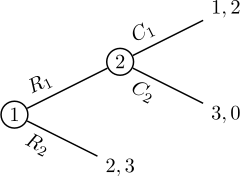
We can use backward induction to predict how the game is going to be played, assuming (1)–(3).
Consider node 2, where Column has a choice between outcome ‘3, 0’ and outcome ‘1, 2’. The choice involves no relevant uncertainty, and Column prefers ‘1, 2’ over ‘3, 0’. He can be expected to play \(C_1\). Anticipating this, Row can figure out that playing \(R_1\) at node 1 will lead to ‘1, 2’. \(R_{2}\) instead leads to ‘2, 3’. This is better for Row. So Row will play \(R_2\).
In the following example, backward induction leads to a more surprising result.
Example 10.3 (Centipede)
You and Bob are playing a game. The game starts with a pot containing £2. In round 1, you can decide whether to continue or end the game. If you end the game, you get the £2 and Bob gets £0. If you continue, the money in the pot increases by £2 and Bob decides whether to continue or end. If he ends the game here (in round 2), the pot is divided so that he gets £3 and you get £1. If he continues, the money in the pot increases by another £2 and it’s your turn again. If you end the game (in round 3), you get £4 and Bob gets £2. And so on. In each round, the money in the pot increases by £2 and whoever ends the game gets £2 more than the other player. In round 100, Bob no longer has an option to continue.
Suppose you and Bob don’t care about each other; each of you only wants to get as much money as possible. Here is a partial diagram of the resulting game.
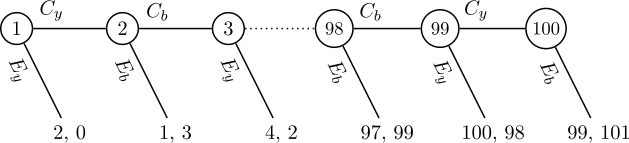
Let’s use backward induction to solve the game. At node 100, Bob doesn’t have a choice. If you continue at node 99 (\(C_{y}\)), you will get £99 and Bob £101. If you end the game (\(E_{y}\)) at node 99, you will get £100. It is obviously better to end the game. Anticipating this, what should Bob do in round 98? If he ends the game (\(E_b\)), he’ll get £99; if he continues (\(C_b\)), he’ll get £98. So he should end the game. Anticipating this, you should end the game in round 97, to ensure that you’ll get £98 rather than £97. And so on, all the way back to round 1. At each point, backward induction tells us that the game should be ended. In particular, you can anticipate in round 1 that Bob will end the game in round 2. So you should end the game in round 1. You will get £2 and Bob £0.
When actual people play the Centipede game, almost no-one ends the game right away. Is this a sign of either altruism or irrationality? Not necessarily.
Let’s look at your choice in round 1 from an MEU perspective. It is clear what happens if you end the game: you’ll get £2. But what would happen if you chose to continue? The argument from backward induction assumes that Bob would end the game. If you could be certain that Bob would do that, then you should indeed end the game in round 1. But why should Bob end the game? Because, so the argument, he can be certain that you would end the game in round 3. But the argument for ending in round 3 is exactly parallel to the argument for ending in round 1. And if Bob faces a choice in round 2, then he has just seen that you did not end the game in round 1. Based on this information, he can’t be sure you would end it in round 3. On the contrary, he should be somewhat confident that you will continue in round 3. And then continuing maximizes expected utility in round 2. Anticipating this, continuing also maximizes expected utility in round 1, as it is likely to get you at least to round 3.
This suggests that the backward induction argument went wrong somewhere. But where? Surely you really ought to end the game in round 99. And surely this means that Bob should end the game in round 98. And so on! This puzzle is sometimes called the paradox of backward induction.
Exercise 10.10 \(\dagger \)\(\dagger \)
Suppose you repeatedly face the Prisoner’s Dilemma with the same partner, for an unknown number of rounds. You only care about your own prison terms. You expect that your partner will remain silent in the first round and from then on imitate whatever you did in the previous round. What should you do? Does your answer show that you should choose a dominated act?
10.6Evolutionary game theory
One of the most successful applications of game theory lies (somewhat surprisingly) in the study of biological and cultural evolution. Consider the following game.
Example 10.4 (The Stag Hunt)
Two players independently decide whether to hunt stag or rabbit. Hunting stag requires cooperation, so if only one of the players decides to hunt stag, she will get nothing. The utilities are as follows.
| Stag | Rabbit | |
| Stag | 5, 5 | 0, 1 |
| Rabbit | 1, 0 | 1, 1 |
In the evolutionary interpretation, the utilities represent the relative fitness that results from a combination of choices, measured in terms of average number of surviving offspring. Let’s assume that each strategy is played by a certain fraction of individuals in a population. Individuals who achieve an outcome with greater utility will, by definition, have more offspring on average, so their proportion in the population will increase.
Suppose initially \(\nicefrac {1}{4}\) of the individuals in the population goes for stags and \(\nicefrac {3}{4}\) for rabbits. Assuming that encounters between individuals are completely random, this means that any given individual has a \(\nicefrac {1}{4}\) chance of playing with someone hunting stag, and a \(\nicefrac {3}{4}\) chance of playing with someone hunting rabbit. The average utility of hunting stag is \(\nicefrac {1}{4} \cdot 5 + \nicefrac {3}{4} \cdot 0 = 1.25\); for hunting rabbit the utility is of course 1. Individuals going for stag have greater average fitness. Their fraction in the population increases. As a consequence, it becomes even more advantageous to go for stag. Eventually, everyone will hunt stag.
By contrast, suppose initially only \(\nicefrac {1}{10}\) of the population goes for stags. Then hunting stag has an average utility of 0.5, which is less than the utility of hunting rabbit. The rabbit hunters will have more offspring, which makes it even worse to hunt stags. Eventually, everyone will hunt rabbits.
The two outcomes ‘Stag, Stag’ and ‘Rabbit, Rabbit’ are the two Nash equilibria in the Stag Hunt. Evolutionary game theory predicts that the proportion of stag and rabbit hunters in a population will approach one of these equilibria.
Not every Nash equilibrium is a possible end point of evolution though. If a population repeatedly plays the game of Chicken, and the players can’t recognize in advance who will swerve and who will go straight, then the asymmetric equilibria ‘Swerve, Straight’ and ‘Straight, Swerve’ do not mark possible end points of evolutionary dynamics. But note that in a community in which almost everyone swerves, you’re better off going straight; similarly, in a community in which almost everyone goes straight, the best choice is to swerve. Evolution will therefore lead to the third, mixed strategy equilibrium. It will lead to a state in which a certain fraction of the population swerves and the others go straight.
The assumption that individuals in a population are randomly paired with one another is obviously an idealisation. In reality, individuals are more likely to interact with members of their own family, which increases the chances that they will be paired with individuals of the same type; they might also actively seek out others who share the relevant traits. Either way, the resulting correlated play dramatically changes the picture.
Imagine a population in which individuals repeatedly play a Prisoner’s Dilemma wherein they can either cooperate (remain silent, in the original scenario) or defect (confess). Since defectors do better than cooperators in any encounter, it may seem that cooperation can never evolve. On the other hand, cooperators do much better when paired with other cooperators than defectors when paired with defectors. If the extent of correlation is sufficiently high, cooperators can take over (although perhaps not completely).
In many species, one can find altruistic individuals who sacrifice their own fitness for the sake of others. Evolutionary game theory explains how this kind of altruism could have evolved.
Exercise 10.11 \(\dagger \)
What are the Nash equilibria in the following game (ignoring randomization)? Could all the equilibria come about through an evolutionary process?
| A | B | |
| A | 5, 5 | 1, 1 |
| B | 1, 1 | 1, 1 |
Essay Question 10.1
Explain the paradox of backward induction. Why is it a paradox? How do you think it could be resolved?
Sources and Further Reading
There are many decent introductions to Game Theory. The “Game Theory” entry in the Stanford Encyclopedia by Don Ross (2019) provides a fairly comprehensive overview. A suitable next step might be Steven Tadelis, Game Theory: An Introduction (2013).
The paradox of backward induction is discussed, for example, in Philip Pettit and Robert Sugden, “The Backward Induction Paradox” (1989).
For a little more on evolutionary game theory, see Brian Skyrms, “Game Theory, Rationality and Evolution of the Social Contract” (2000). For even more, see Brian Skyrms, “The Stag Hunt and the Evolution of Social Structure” (2004).