8Why MEU?
8.2 Money pumps and sequential choice
8.3 The long run
8.4 Risk aversion
8.5 Redescribing the outcomes
8.1Arguments for the MEU Principle
So far, we have largely taken for granted that rational agents maximize expected utility. It is time to put this assumption under scrutiny.
In chapter 1, I gave a simple initial argument for the MEU Principle. An adequate decision rule, I said, should consider all the outcomes an act might bring about – not just the best, the worst, or the most likely – and should weigh outcomes in proportion to their probability, so that more likely outcomes are given proportionally greater weight.
In chapter 5, we looked at the internal structure of utility. I didn’t mention it at the time, but the account we developed can be used to support the MEU Principle.
Consider a schematic decision matrix with \(n\) states \(S_{1},\ldots ,S_{n}\). The expected utility of an act \(A\) is \[ \EU (A) = \U (O_{1})\cdot \Cr (S_{1}) + \ldots + \U (O_{n})\cdot \Cr (S_{n}). \] In an adequate decision matrix, any act \(A\) in conjunction with any state \(S_{i}\) should determine the relevant outcome \(O_{i}\), so that \(S_{i} \land A\) entails \(O_{i}\). Since outcomes have uniform utility, it follows that \(\U (A \land S_{i}) = \U (O_{i})\), for all \(i\). Thus \[ \EU (A) = \U (A \land S_{1})\cdot \Cr (S_{1}) + \ldots + \U (A \land S_{n})\cdot \Cr (S_{n}). \]
In an adequate decision matrix, the states are independent of the acts. This suggests that \(\Cr (S_{i} / A) = \Cr (S_{i})\). So \[ \EU (A) = \U (A \land S_{1})\cdot \Cr (S_{1}/A) + \ldots + \U (A \land S_{n})\cdot \Cr (S_{n}/A). \]
In section 5.3, I mentioned a “partition formulation” of Jeffrey’s axiom. This says that for any proposition \(A\) and partition \(S_{1},\ldots ,S_{n}\), \[ \U (A) = \U (A \land S_{1})\cdot \Cr (S_{1}/A) + \ldots + \U (A \land S_{n})\cdot \Cr (S_{n}/A). \] Since the states in a decision matrix form a partition, it follows that \(\EU (A) = \U (A)\): the expected utility of an act equals its utility.
It might seem strange to speak of an act’s utility. When we use the MEU Principle, we assign utilities to outcomes and expected utilities to acts. We never talk about the utility of an act. In the terminology of chapter 5, each outcome is a “concern”, as it settles everything the agent cares about. The theory of utility that we developed in chapter 5 allows us to extend an agent’s “intrinsic” utility function for concerns to other propositions. In particular, we can talk about the utility of propositions that specify an act.
An act’s utility measures how strongly the agent desires to perform the act. Assuming the theory of utility from chapter 5, the MEU principle reduces to the seemingly innocuous claim that rational agents choose an act that they desire to perform at least as strongly as any alternative. (We are going to challenge this seemingly innocuous claim in chapter 9.)
In chapter 6, we met yet another argument for the MEU Principle. The argument began with an idea about how to measure (or define) an agent’s intrinsic utility function. The idea was to look at the agent’s preferences between outcomes and lotteries. Assuming that the agent always chooses a most preferred option, von Neumann’s construction of utility entails that an agent obeys the MEU Principle (in choices between lotteries) iff their preferences satisfy certain “axioms”: Transitivity, Completeness, Continuity, Independence, and Reduction.
To complete this argument for the MEU Principle (for choices between lotteries), we would need to explain why the axioms should be considered requirements of rationality. Why should rational preferences satisfy Transitivity, Completeness, Continuity, Independence, and Reduction?
Here is an attractive answer: if an agent violates these axioms, then they will make patently bad choices in certain multi-stage decision problems.
To illustrate, suppose your preferences violate the Transitivity axiom. You prefer \(A\) to \(B\), \(B\) to \(C\), but \(C\) to \(A\). Your preferences form a cycle. Whichever of \(A\), \(B\) or \(C\) you have, you would prefer to have one of the others. If you are willing to pay a small amount to get the preferred option, it looks like I could exploit you in a kind of multi-stage Dutch Book.
Concretely, let’s assume you start out with \(C\). Since you prefer \(B\) to \(C\), you should be willing to pay an insignificant amount (say, 1p) if I let you swap \(C\) for \(B\). Once you have \(B\), I let you swap \(B\) for \(A\) in exchange for another penny. You should be happy to do that, given that you prefer \(A\) to \(B\). Finally, I let you swap \(A\) for \(C\), again in exchange for 1p. You should accept, as you prefer \(C\) to \(A\). You are back where you started, with \(C\), and I have gained three pence. We could start over, letting you swap \(C\) for \(B\) for \(A\) for \(C\) until I have emptied your wallet.
This kind of argument is called a money-pump argument (for obvious reasons). It’s worth spelling out in more detail. In its present form, the argument has a serious flaw.
8.2Money pumps and sequential choice
We are looking at an agent with cyclical preferences: \begin {gather*} A \pref B\\[0.5em] B \pref C\\[0.5em] C \pref A \end {gather*} We imagine presenting this agent (“you”) with a sequence of choices. A decision problem with more than one choice is called a sequential decision problem. The branch of decision theory that studies sequential decision problems is called sequential decision theory or dynamic decision theory. Our money-pump argument invites us to take a brief look into this area.
We have assumed that you start with \(C\). At the first choice point in our money-pump scenario, you can either keep \(C\) or exchange \(C\) for \(B\), at a small cost. Let \(B^{\text {-}}\) express \(B\) with the added small cost: \(B^{\text {-}} = B \land \)-1p. So your first choice is between \(C\) and \(B^{\text {-}}\). If you choose \(B^{\text {-}}\), you get the option to pay another penny to swap \(B\) for \(A\). If you accept, you are left with \(A^{\text {-}\text {-}}\) = \(A \land \)-2p. You are then offered a third choice, in which you can stick with \(A^{\text {-}\text {-}}\) or end up with \(C^{\text {-}\text {-}\text {-}} = C \land \)-3p.
We can picture the whole sequential decision problem in a tree diagram, called an extensive form representation.
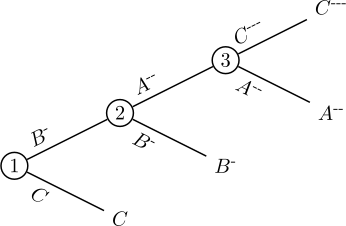
The circled nodes are choice points. What path through this tree would you take?
Above, I assumed that you would choose \(B^{\text {-}}\) at node 1. My reasoning was that you prefer \(B\) to \(C\), and we take for granted that the preference is strong enough that you also prefer \(B^{\text {-}}\) to \(C\). For analogous reasons, I assumed that you would choose \(A^{\text {-}\text {-}}\) at node 2 (because you prefer \(A\) to \(B\)), and \(C^{\text {-}\text {-}\text {-}}\) at node 3 (because you prefer \(C\) to \(A\)). You end up with \(C^{\text {-}\text {-}\text {-}} = C \land \)-3p, even though you could have gotten \(C\) at no cost by “turning right” at the first node.
But would you really make these choices?
Look again at node 1. Superficially, you are here offered a choice between \(C\) and \(B^{\text {-}}\). But if you “choose \(B^{\text {-}}\)” you aren’t actually getting \(B^{\text {-}}\) unless you “turn right” at node 2. If you turn left at node 2 and again at node 3, as we assumed you will, then “choosing \(B^{\text {-}}\)” at node 1 actually means getting \(C^{\text {-}\text {-}\text {-}}\). And \(C^{\text {-}\text {-}\text {-}}\) is worse than \(C\). If you can foresee that you will turn left at nodes 2 and 3, then you will not turn left at node 1.
The flaw in my argument is that I have ignored any information you might have about your predicament and about what you might do at later stages in the scenario. We have adopted what is called a myopic approach to sequential choice. The myopic approach treats each choice as if it were the only decision the agent ever faces, ignoring any downstream consequences. We shouldn’t be myopic. An adequate evaluation of the agent’s options should take into account what the agent is likely to do later. This approach to sequential choice is called sophisticated.
To investigate our decision problem from a sophisticated perspective, we need to say what you know about your situation. Let’s assume that you are fully informed about the sequential decision problem. Let’s also assume that you have perfect knowledge of your preferences, so that you can figure out what you will do at any future choice point.
What you should do at node 1 now depends on what you might do at node 2, which similarly depends on what you might do at node 3. But if there are no relevant choices after node 3 then we can figure out what you would do here. The choice at node 3 is between \(A^{\text {-}\text {-}}\) and \(C^{\text {-}\text {-}\text {-}}\). Since you prefer \(C\) to \(A\), it is plausible that you will choose \(C^{\text {-}\text {-}\text {-}}\).
With this information in hand, we can return to node 2. Your choice at node 2 is effectively between \(C^{\text {-}\text {-}\text {-}}\) (via node 3) and \(B^{\text {-}}\). You prefer \(B\) to \(C\). So we can expect you to choose \(B^{\text {-}}\) at node 2.
Now return to node 1. Given what we have just figured out, the choice at node 1 is effectively between \(C\) and \(B^{\text {-}}\). You prefer \(B\) (and \(B^{\text {-}}\)) to \(C\). We may therefore expect you to choose \(B^{\text {-}}\) at node 1. You will “turn left” at node 1 and right at node 2.
This kind of reasoning is called backward induction. We’ll meet it again in section 10.5, where we will see that it is not as harmless as it might appear.
Exercise 8.1 \(\dagger \)\(\dagger \)\(\dagger \)
Draw a decision matrix (without utilities) for your choice at node 1.
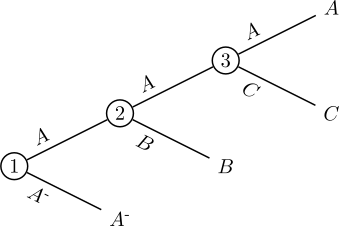
The money pump argument from the previous section doesn’t work – at least not if you know about my plot. But this can be fixed. In the following sequential decision problem, an agent who prefers \(A\) to \(B\) to \(C\) to \(A\) would trade \(A\) for \(A^{\text {-}}\) at node 1, assuming they know about the scenario and their preferences. They would make a guaranteed and avoidable loss of 1 penny.
Exercise 8.2 \(\dagger \)\(\dagger \)
Explain by backward induction why “you” (the agent with cyclical preferences) would choose \(A^{\text {-}}\) at node 1.
Exercise 8.3 \(\dagger \)
Which choices would you make at which nodes if your preferences were transitive, so that \(A \pref B\), \(B \pref C\), and \(A \pref C\)?
The real point is, of course, not about money. The point is that cyclical preferences effectively lead to the choice of a dominated strategy. You could have gotten \(A\), by “turning left” at each node. Due to your cyclical preferences, you end up with a strictly worse outcome \(A^{\text {-}}\).
We have assumed that you prefer \(A\) to \(B\), \(B\) to \(C\), and \(C\) to \(A\). Not all violations of Transitivity involve cycles of this kind. Instead of preferring \(C\) to \(A\), you could be indifferent between \(C\) and \(A\). You could also have no attitude at all about the comparison between \(A\) and \(C\), violating both Transitivity and Completeness. These preferences, too, can be shown to support the choice of a dominated strategy. The same is true, more generally, for (almost) all preferences that violate the von Neumann and Morgenstern axioms.
8.3The long run
I want to look at one more argument for the MEU Principle. This one turns on a connection between probability and relative frequency.
Suppose you repeatedly toss a fair coin, keeping track of the number of heads and tails. You will find that over time, the proportion of heads approaches its objective probability, \(\nicefrac {1}{2}\). After one toss, you will have 100% heads or 100% tails. After ten tosses, it’s very unlikely that you’ll still have 100% heads or 100% tails. 60% heads and 40% tails wouldn’t be unusual. The (objective) probability of getting 40% tails or less in 10 independent tosses of a coin is 0.377. For 100 tosses, it is 0.028; for 1000, it is less than 0.000001. After 1000 tosses, the probability that the proportion of tails lies between 45% and 55% is 0.999.
In general, the rules of probability entail that if there is a sequence of “trials” \(T_1,T_2,T_3\ldots \) in which the same outcomes (like heads and tails) can occur with the same probabilities, then the probability that the proportion of any outcome in the sequence differs from its probability by more than an arbitrarily small amount \(\epsilon \) converges to 0 as the number of trials gets larger and larger. This is known as the (weak) law of large numbers. Loosely speaking: in the long run, probabilities turn into proportions.
How is this relevant to the MEU Principle? Consider a bet on a fair coin flip: if the coin lands heads, you get £1, otherwise you get £0. The bet costs £0.40. If you are offered this deal again and again, the law of large numbers entails that the percentage of heads will (with high probability) converge to 50%. If you buy the bet each time, you can be confident that you will lose £0.40 in about half the trials and win £0.60 in the other half. The £0.10 expected payoff turns into an average payoff. In this kind of scenario, the MEU Principle effectively says that you should prefer acts with greater average utility (and therefore greater total utility) over acts with lower average (and total) utility. If you face the same decision problem over and over, you are almost certain to achieve greater total utility if you follow the MEU Principle than if you follow any other rule.
In reality, of course, there are limits to how often one can encounter the very same decision problem. “In the long run, we are all dead”, as John Maynard Keynes quipped. Fortunately, we saw in the coin flip example that the convergence of proportions to probabilities tends to be quick. It does not take millions of tosses until the percentage of heads is almost certain to exceed 40%.
As it stands, the long-run argument still assumes that the same decision problem is faced over and over. But we can weaken this assumption. Suppose you face a sequence of decision problems that may involve different outcomes, different states, and different probabilities. One can show that if the states in these problems are probabilistically independent, and the relevant probabilities and utilities are not too extreme, then over time, maximizing expected utility is likely to maximize average (and total) utility.
From all this, you might expect that professional gamblers and investors generally put their money on the options with greatest expected payoff, since this would give them the greatest overall profit in the long run. But they do not. (Those who do don’t remain professional gamblers or investors for long.) To see why, imagine you are offered an investment in a startup that tries to find a cure for snoring. If the startup succeeds, your investment will pay back tenfold. If the startup fails, the investment is lost. The chance of success is 20%, so the expected return is \(0.2 \cdot 1000\% + 0.8 \cdot 0\% = 200\%\). Even if this exceeds the expected return of all other investment possibilities, you would be mad to put all your money into this gamble. If you repeatedly face this kind of decision and go all-in each time, then after ten rounds you are bankrupt with a probability of \(1-0.2^{10} = 0.9999998976\).
This does not contradict the law of large numbers. In the startup example, you are not facing the same decision problem again and again. If you lose all your money in the first round, you don’t have anything left to invest in later rounds. Still, the example illustrates that by maximizing expected utility you don’t always make it likely that you will maximize average or total utility in the long run. More importantly, the example suggests that there is something wrong with the MEU Principle. Sensible investors balance expected returns and risks. A safe investment with lower expected returns is often preferred to a risky investment with greater expected returns. Shouldn’t we adjust the MEU Principle, so that agents can factor in the riskiness of their options?
Exercise 8.4 \(\dagger \)\(\dagger \)
Every year, an investor is given £100,000, which she can either invest in a risky startup of the kind described (a different one each year), or put in a bank account at 0% interest. If she always chooses the second option, she will have £1,000,000 after ten years.
- (a)
- What are the chances that she would do at least as well (after ten years) if she always chooses the first option, without reinvesting previous profits?
- (b)
- How does the answer to (a) mesh with my claim in the text that an investor who always goes with the risky option is virtually guaranteed to go bankrupt?
8.4Risk aversion
Many people are risk averse, at least for certain kinds of choices. They prefer situations with a predictable outcome over highly unpredictable situations. This does not seem irrational. Does it pose a threat to the MEU Principle?
A standard way to measure risk aversion involves lotteries. Consider a lottery with an 80% chance of £0 and a 20% chance of £1000. The expected payoff is £200. Given a choice between the lottery and £100 for sure, a risk averse agent might prefer the £100. Can we account for these preferences?
We can. We could, for example, assume that the difference in utility between £1000 and £100 is, for this agent, less than five times the difference in utility between £100 and £0. For example, if \(\U (\text {£0}) = 0\), \(\U (\text {£100}) = 1\), and \(\U (\text {£1000}) = 4\), then the lottery has expected utility \(0.8 \cdot 0 + 0.2 \cdot 4 = 0.8\), which is less than the guaranteed utility of the £100.
This is how economists model risk aversion. They assume that for risk averse agents, utility is a “concave function of money”, meaning that the amount of utility that an extra £100 would add to an outcome of £1000 is less than the amount of utility the same £100 would add to a lesser outcome of, say, £100. We have already encountered this phenomenon in chapter 5, where we saw that money has declining marginal utility: the more you have, the less utility you get from an extra £100. According to standard economics, risk aversion is the flip side of declining marginal utility.
This should seem strange. Intuitively, the fact that the same amount of money becomes less valuable the more money you already have has nothing to do with risk. Money could have declining marginal utility even for an agent who loves the thrill of risky options. Conversely, an agent might value every penny as much as the previous one, but shy away from risks.
No doubt some actions that appear to display risk aversion (say, among professional gamblers) are really explained by the declining marginal utility of money. But many people prefer predictable situations in a way that can’t be explained along these lines. The following example is due to Maurice Allais.
Example 8.1 (Allais’s Paradox)
A ball is drawn from an urn containing 80 red balls, 19 green balls, and 1 blue ball. Consider first a choice between the following two lotteries. Which do you prefer?
| Red (0.8) | Green (0.19) | Blue (0.01) | |
| \(A\) | £0 | £1000 | £1000 |
| \(B\) | £0 | £1200 | £0 |
Next, consider the alternative lotteries \(C\) and \(D\), based on the same draw from the urn. Which of these do you prefer?
| Red (0.8) | Green (0.19) | Blue (0.01) | |
| \(C\) | £1000 | £1000 | £1000 |
| \(D\) | £1000 | £1200 | £0 |
If you choose \(C\) in the second choice, you get £1000 for sure. If you choose \(D\), you get either £1000 (most likely) or £0 (least likely) or £1200. If you’re risk averse, it makes sense to take the sure £1000.
In the first choice, the most likely outcome is £0 no matter what you do. It may seem reasonable to take the 19% chance of getting £1200 (by choosing \(B\)) rather than the 20% chance of getting £1000 (by choosing \(A\)).
Many people, when confronted with Allais’s puzzle, seem to reason in this way. They prefer \(C\) to \(D\) and \(B\) to \(A\). These preferences can’t be explained by the declining marginal utility of money. Indeed, there is no way of assigning utilities to monetary payoffs that makes a preference of \(C\) over \(D\) and \(B\) over \(A\) conform to the MEU Principle. If you have the risk averse preferences, you appear to violate the MEU Principle.
Exercise 8.5 \(\dagger \)\(\dagger \)\(\dagger \)
The preference for \(C\) over \(D\) and \(B\) over \(A\) appears to violate the Independence axiom of von Neumann and Morgenstern. Explain. (The axiom states that, for any \(A, B, C\), if \(A \succsim B\), and \(L_1\) is a lottery that leads to \(A\) with some probability \(x\) and otherwise to \(C\), and \(L_2\) is a lottery that leads to \(B\) with probability \(x\) and otherwise to \(C\), then \(L_1 \succsim L_2\). You can assume Completeness.)
Some say that the kind of risk aversion that is manifested by a preference of \(B\) over \(A\) and \(C\) over \(D\) is irrational. Rational agents, they say, can’t prefer predictable situations over unpredictable situations. This might be OK if our topic were a special kind of “economic rationality”. But it’s not OK if we’re interested in a general model of how coherent beliefs and desires relate to choice. There is nothing incoherent about a desire for predictability.
The following scenario, presented as a counterexample to the MEU Principle by Mark J. Machina, reinforces this verdict.
Example 8.2
A mother has a treat that she can give either to her daughter Abbie or to her son Ben. She considers three options: giving the treat to Abbie, giving it to Ben, and tossing a fair coin, so that Abbie gets the treat on heads and Ben on tails. Her decision problem might be summarized by the following matrix (assuming for simplicity that if the mother decides to give the treat directly to one of her children, she nonetheless tosses the coin, just for fun).
| Heads | Tails | |
| Give treat to Abbie (\(A\)) | Abbie gets treat | Abbie gets treat |
| Give treat to Ben (\(B\)) | Ben gets treat | Ben gets treat |
| Let the coin decide (\(C\)) | Abbie gets treat | Ben gets treat |
The mother’s preferences are \(C \succ A\), \(C \succ B\), \(B \succ A\).
As in Allais’s Paradox, there is no way of assigning utilities to the outcomes in the decision matrix in example 8.2 that makes the mother’s preferences conform to the MEU Principle. Yet these preferences are surely not irrational. The mother prefers \(C\) because it is the most fair of the three options. It would be absurd to claim that rational agents cannot value fairness.
8.5Redescribing the outcomes
When confronted with an apparent counterexample to the MEU Principle, the first thing to check is always whether the decision matrix has been set up correctly. In particular, we need to check if the outcomes in the matrix specify everything that matters to the agent.
Consider the bottom right cell of the second matrix in example 8.1. What will happen if you choose \(D\) and the blue ball is drawn? You get £0. But you might also feel frustrated about your bad luck: there was a 99% chance of getting at least £1000, and you got nothing! You probably don’t like feeling frustrated. If so, the feeling should be included in the outcome. The outcome in the bottom right cell of the second matrix should say something like ‘£0 and considerable frustration’.
By contrast, consider the bottom right cell in the first matrix. If you choose \(B\) and the blue ball is drawn, you get £0. The chance of getting £0 was 81%, so you’ll be much less frustrated about your bad luck. The outcome in that cell might say something like ‘£0 and a little frustration’. With these changes, the preference for \(B\) over \(A\) and \(C\) over \(D\) is easily reconciled with the MEU Principle.
Exercise 8.6 \(\dagger \)
Assign utilities to the outcomes in the two matrices, with the changes just described, so that \(\EU (B) > \EU (A)\) and \(\EU (C) > \EU (D)\).
Do these changes reflect the values of a risk averse agent? Arguably not. Just as (genuine) risk aversion is not the same as declining marginal utility of money, it is not the same as fear of frustration. Imagine you face Allais’s Paradox towards the end of your life. The ball will be drawn after your death, and the money will go to your children. You will not be around to experience frustration or regret. Nor might your children, if the whole process is kept secret from them. But if you like predictable outcomes, you might still prefer \(B\) to \(A\) and \(C\) to \(D\).
Let’s ask again what will happen if you choose \(D\) and the blue ball is drawn. One thing that will happen is that you get £0. You may or may not experience frustration and regret. But here’s another thing that is guaranteed to happen. You will have chosen a risky option instead of a safe (predictable) alternative. If you are risk averse, then plausibly (indeed, obviously!) you care about whether your choices are risky. So we should put that into the outcome. The outcome should say something like ‘£0 and incurred avoidable risk’.
The outcome in the bottom right cell of the first matrix does not have the second attribute, that you have incurred an avoidable risk. There is no safe alternative in the first matrix. We can once again distinguish the two outcomes, and reconcile your preferences with the MEU Principle.
Exercise 8.7 \(\dagger \)
If you care about predictability and risk, then we should also distinguish the outcomes in all other cells of the matrix. Can you explain how?
Exercise 8.8 \(\dagger \)
Redescribe the outcomes in example 8.2 so that the mother’s preferences conform to the MEU Principle.
When social scientists discuss the MEU Principle, they generally assume that utility is assigned to material goods (as I mentioned in section 5.2). On this approach, an outcome in a decision matrix can only specify who owns which goods. Agents who care about frustration, predictability, or fairness are said to violate the MEU Principle.
There are reasons for this restricted conception of utility. Assuming that consumers maximise expected utility, in the restricted sense, and that material goods have declining marginal utility, one can derive various “laws” of microeconomics, such as the “law of demand”. Even if people don’t actually maximise expected utility, in the restricted sense, their behaviour as consumers might approximate what the economics version of our model predicts to make the model theoretically useful.
But our goal is not to derive the laws of microeconomics from substantive assumptions about what people ultimately care about. Our goal is to develop a general model of belief, desire, and rational choice. In this context, we don’t want to put unnecessary and unrealistic constraints on what agents might desire. We want to allow for agents who care about frustration, predictability, fairness, and all sorts of other things.
Authors in the economics tradition sometimes consider models in which an agent’s choices are assumed to be determined by their desire towards material goods, as reflected in their utility function, as well as their desire towards a specific further attribute – anticipated regret, for example, or riskiness. The MEU Principle is then revised to make room for the further parameter besides the agent’s credence function and the utility function for material goods. But this approach clearly doesn’t generalise well. We have instead followed a popular tradition in philosophy that puts no substantive constraints at all on the objects of utility.
I should emphasize that these two approaches are not necessarily in tension. We are simply engaged in different projects.
A common objection to our unrestrictive conception of utility is that it seems to render the MEU Principle vacuous. In the economics interpretation, the MEU Principle predicts that rational agents don’t choose \(B\) over \(A\) and \(C\) over \(D\) in Allais’s Paradox. It also predicts that rational agents never toss a coin to decide who gets a treat. Our MEU Principle makes no such predictions. Indeed, for any pattern of behaviour, we can imagine that the agent has a basic desire to display just that behaviour. Displaying the behaviour then evidently maximizes expected utility. No behaviour whatsoever is, all by itself, ruled out by our MEU Principle.
This isn’t necessarily a problem – not even for a descriptive understanding of the principle. Many respectable scientific theories are unfalsifiable in isolation. Scientific hypotheses can generally only be tested in conjunction with a whole range of background assumptions.
The same is true for the MEU Principle, understood as a descriptive hypothesis about human behaviour. Given some assumptions about an agent’s beliefs and desires, we can easily find that their choices do not conform to the MEU Principle. And we often have good evidence about the relevant beliefs and desires. It is safe to assume that participants in the world chess tournament want to win their games, and that they are aware of the current position of the pieces in the game.
I said that any pattern of behaviour is compatible with the MEU Principle. Didn’t von Neumann and Morgenstern prove that an agent maximizes expected utility in choices between lotteries if and only if their preferences (and therefore, one might think, their choice dispositions) satisfy some non-trivial conditions – Transitivity, Continuity, Independence, etc.?
Not quite. The proof of this result assumes that the agent’s (intrinsic) utilities are determined by von Neumann’s method. And here we reach a genuine downside to our approach: it breaks von Neumann’s method.
Suppose, for example, we want to determine the intrinsic utility function for the mother in example 8.2. Let \(a\) and \(b\) be the outcomes of directly giving the treat to Abbie and to Ben, respectively. If the mother cares about fairness, then one relevant aspect of both \(a\) and \(b\) is that the treat is not allocated through a chance process. By von Neumann’s method, we should now ask whether the mother prefers some other outcome \(c\) to a lottery \(L\) between \(a\) and \(b\). This lottery would be a chance process that leads to outcomes which don’t come about through a chance process. That’s logically impossible. \(L\) entails that one of \(a\) and \(b\) comes about, and it also entails that neither of them come about. We can hardly assume that the mother has interesting views about how \(L\) compares to \(c\).
In general, if we allow agents to care about arbitrary aspects of outcomes, then we can’t assume that any lottery between outcomes is logically possible. Either the Completeness axiom or most of the other axioms become highly implausible.
This is a genuine cost. We lose a popular approach to defining utility, and a popular argument for the MEU Principle.
Exercise 8.9 \(\dagger \)\(\dagger \)\(\dagger \)
The money-pump argument for Transitivity from section 8.2 also makes substantive assumptions about what the agent (“you”) ultimately cares about. Explain.
Similar problems arise for other attempts to measure utility in terms of preference, and to justify the MEU Principle. The popular theory of Leonard Savage, for example, also assumes that an agent’s utility function pertains to a restricted set of “outcomes” that are logically independent of the “states” to which credences are assigned.
Ramsey’s approach, however, might still work. Remember that instead of lotteries, Ramsey uses gambles of the form ‘\(a\) if \(N\), \(b\) if \(\neg N\)’, where \(N\) is some proposition the agent doesn’t care about and \(a\) and \(b\) are among the agent’s concerns. If we understand such a gamble as a possible act that leads to \(a\) if \(N\) and otherwise to \(b\), then the gamble may become logically impossible – if, for example, \(a\) entails that no such act is performed. But we don’t have to interpret gambles as hypothetical acts. A gamble could simply be a certain kind of conditional proposition.
A clear example of a preference-based approach that imposes no substantive constraints on basic desires was developed by Ethan Bolker and Richard Jeffrey in the 1960s. Where von Neumann uses lotteries and Ramsey gambles, Bolker and Jeffrey use unspecific propositions. If \(a\) and \(b\) are two concerns, then the disjunction \(a \lor b\) behaves somewhat like a lottery that “leads to” (i.e., amounts to) \(a\) with some probability (credence) and to \(b\) with another. As long as \(a\) and \(b\) are consistent, \(a \lor b\) is guaranteed to be consistent as well.
Normally, the aim of a preference-based approach is to show that if an agent’s preferences satisfy some plausible conditions (“axioms”), then the preferences can be represented by a utility function \(\U \), perhaps together with a credence function \(\Cr \), relative to which the agent ranks the things over which the preferences are defined by expected utility. Jeffrey and Bolker’s preference relation is defined over arbitrary propositions. It isn’t clear how we should understand the “expected utility” of, say, a disjunction \(a \lor b\). But we’ve seen above, in section 8.1, that Jeffrey’s concept of utility, which we have adopted since chapter 5, can be seen to generalise the concept of expected utility. Jeffrey and Bolker show that if an agent’s preferences satisfy certain axioms, then the preferences can be represented by a utility function \(\U \) and a credence function \(\Cr \) relative to which the agent ranks propositions in line with Jeffrey’s axiom.
So we might still be able to derive utility from preference – although the relevant preferences, relating arbitrary propositions, are even further removed from choice dispositions than in von Neumann’s or Ramsey’s construction.
Exercise 8.10 \(\dagger \)\(\dagger \)\(\dagger \)
Imagine you have an anti-rational streak: one of your basic desires is to not maximise expected utility. For simplicity, suppose your only other basic desire is to be free from pain, and it is weaker than your desire to not maximize expected utility. You wonder whether to bang your head against the wall. What does the MEU Principle say you should do?
Essay Question 8.1
In section 7.5, we looked at Harsanyi’s argument for utilitarianism. The argument involves lotteries, and seems to rely on von Neumann’s construction of utility. This suggests that the argument rests on implicit assumptions about what each individual may care about. Evaluate the prospects of trying to resist the argument on these grounds.
Sources and Further Reading
A useful survey of money-pump arguments for the von Neumann and Morgenstern axioms is Johan E. Gustafsson, Money-Pump Arguments (2022). Katie Steele, “Dynamic Decision Theory” (2018) briefly summarizes some of the philosophical controversy over these arguments.
I don’t know any good literature on the long-run argument. I describe some moves towards generalising the argument beyond cases where the agent faces the same decision problem over and over at www.umsu.de/wo/2018/678.
For an intro to Allais’s Paradox, see Philippe Mongin, “The Allais paradox: What it became, what it really was, what it now suggests to us” (2019). The example of the mother and the treat is from Mark J. Machina, “Dynamic Consistency and Non-Expected Utility Models of Choice Under Uncertainty” (1989).
That risk aversion should be handled by including risk as an “attribute” of outcomes is defended, for example, in Paul Weirich, “Expected Utility and Risk” (1986). For arguments against our liberal approach to utility, see Jean Baccelli and Philippe Mongin, “Can redescriptions of outcomes salvage the axioms of decision theory?” (2021) and chapter 4 of Lara Buchak, Risk and Rationality (2013).
The Jeffrey-Bolker construction is described in chapter 9 of Richard Jeffrey, The Logic of Decision (1965/83). Unless the agent’s utilities are unbounded, Jeffrey and Bolker actually don’t manage to secure a unique representation. On this issue, see, for example, James Joyce, “Why we still need the logic of decision” (2000).