Lewis 1969 on the probability of conditionals
I finally got around to adding the papers from Janssen-Lauret and Macbride 2023 to the search corpus at https://www.david-lewis.org. It's a wonderful collection with lots of treasures. I want to comment on an intriguing passage on pp.71f., from an abandoned 1969 textbook project on confirmation theory.
First, some context. At this point in the manuscript, Lewis has introduced \(\mathcal{M}\) as a probability measure on the propositions expressible in a language \(\mathcal{L}\) with classical boolean connectives; \(\mathcal{C}\) is the associated conditional probability measure, defined by the ratio formula. Lewis notes that conditional probabilities are often read as "the probability of C if A", which suggests that \(\mathcal{C}(C/A)\) might equal \(\mathcal{M}(C\textit{ if }A)\), where '\(C\textit{ if }A\)' is the material conditional. But that's obviously false. Lewis continues:
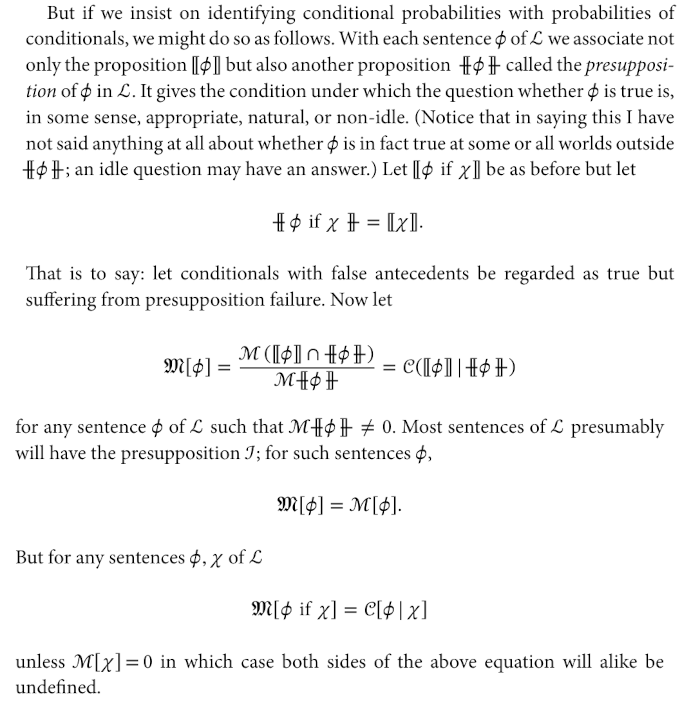
Lewis here suggests that one can identify conditional probabilities with probabilities of conditionals – a hypothesis that he famously refuted in Lewis 1976.
Lewis's proposal has two parts.
The first is a slight revision to the material analysis of conditionals: '\(C\textit{ if }A\)' has the truth-conditions of the material conditional, but also carries a "presupposition" that \(A\) is true.
We then define, in the second part, a new probability measure \(\mathfrak{M}\) on the sentences of \(\mathcal{L}\), which conditionalizes on the presupposition of the sentences to which it is applied. If \(A\) and \(C\) carry no presupposition, it follows that \(\mathfrak{M}(C\textit{ if }A) = \mathcal{C}(C/A)\).
Nolan 2026, 246f. comments on this passage:
Lewis's proposal here fails, so far as I can see, for the same reasons so many other accounts of the probability of the conditional in terms of conditional probability fail, especially when embedded conditionals are considered. (See Lewis's Lewis 1976 and Lewis 1986 and Hájek 1989 for some among many of the technical problems.)
I disagree. Lewis's proposal is incomplete. But it doesn't fall prey to triviality results, for essentially the same reason for which the trivalent approach to conditionals, going back to de Finetti 1936, avoids triviality.
On the trivalent approach, '\(C\textit{ if }A\)' is true if \(A\) and \(C\) are both true, false if \(A\) is true and \(C\) false, and "undefined" if \(A\) is false. One can then define a sentential probability operator \(P^*\) that satisfies the usual axioms for bivalent sentences (i.e., for sentences that are never undefined) and that evaluates non-bivalent sentences by conditionalizing on definedness, so that \(P^*(A)\) is the probability that \(A\) is true conditional on \(A\) having a truth-value. For bivalent \(A\) and \(C\), we then have \(P^*(C\textit{ if }A) = P^*(C/A)\).
The third truth-value here plays essentially the same role as the presupposition in Lewis's account. Its effect is that conditionals are associated with two regions in logical space, one of which serves to restrict the probability operator \(P^*\), the other to divide the worlds in the restricted set into those where the conditional is true and those where it is false.
On the trivalent approach, we have further work to do. We have to decide how negation, conjunction, and disjunction work if one of the arguments has the "undefined" truth-value. We also have to decide how to interpret conditionals with undefined antecedents or consequents, and whether entailment should be understood in terms of preservation of truth or in terms of preservation of non-falsity.
Analogous questions arise for the presuppositional approach. Here, we have to decide how the presuppositions of complex sentences are determined, and whether entailment should be understood in terms of simple truth-preservation or in terms of truth-preservation when the presuppositions of the conclusion are satisfied ("Strawson entailment").
Lewis says nothing about these issues. That's why his account is incomplete. For example, Lewis doesn't tell us if a nested conditional \(A \Rightarrow (B \Rightarrow C)\) presupposes just \(A\) or if the presupposition of the embedded conditional projects to the whole sentence, so that \(A \Rightarrow (B \Rightarrow C)\) presupposes \(A \land B\). The latter option seems better. It predicts that \(\mathfrak{M}(A \Rightarrow (B \Rightarrow C)) = \mathcal{C}(C/A \land B)\).
Note that, in this case, we usually don't have \(\mathfrak{M}(A \Rightarrow(B \Rightarrow C)) = \mathcal{C}(B \Rightarrow C \;/\; A)\), since \(\mathcal{C}(B \Rightarrow C \;/\;A) = \mathcal{C}(B \supset C \;/\; A)\), and this usually won't equal \(\mathcal{C}(C/A \land B)\). So the last sentence in the displayed passage isn't quite right: the equality \(\mathfrak{M}(C\textit{ if }A) = \mathcal{C}(C/A)\) only holds if \(C\) doesn't itself carry a nontrivial presupposition.
The problem with the equality \(\mathfrak{M}(C\textit{ if }A) = \mathcal{C}(C/A)\) is that the conditional probability operator \(\mathcal{C}\) is insensitive to presuppositions. In a more comprehensive account, we'd want to introduce a presupposition-sensitive conditional probability operator \(\mathfrak{C}\) that relates to \(\mathcal{C}\) in the way \(\mathfrak{M}\) relates to \(\mathcal{M}\). For presupposition-free \(C\), we'll have \(\mathfrak{C}(C/A) = \mathcal{C}(C/A)\). But if \(C\) carries presupposition \(P\), we'll want to conditionalize on that presupposition, so that \(\mathfrak{C}(C/A) = \mathcal{C}(C\;/\;A\land P)\).
So the right equality is \(\mathfrak{M}(C\textit{ if }A) = \mathfrak{C}(C/A)\). This holds even if \(C\) is itself a conditional.
Compared to the trivalent approach, Lewis's presuppositional approach seems to have some advantages.
Remember that the trivalent approach has to decide how conjunction and disjunction etc. behave when one of the arguments has "undefined" truth-value. It's natural to think (with de Finetti) that \(A \land B\) is true only if \(A\) and \(B\) are both true. But then a "partitioning sentence" of the form '\((C\textit{ if }A) \land (D\textit{ if }\neg A)\)' could never be true: one of the conjuncts must have a false antecedent, which renders that conjunct undefined. But many such sentences are surely true.
To avoid this problem, we'd have to say that \(A \land B\) is true not only if \(A\) and \(B\) are both true, but also if one of \(A\) and \(B\) is true and the other is undefined. (Égré, Rossi, and Sprenger 2021 tentatively endorse this response.) But then conjoining a conditional with a tautology turns the conditional into a material conditional and we predict that \(P^*(\top \land (C\text{ if }A)) = P^*(A \supset C)\), which seems wrong.
So the trivalent account seems forced to make false predictions either about partitioning sentences or about conditionals conjoined with tautologies.
Lewis's presuppositional account has more flexibility. The presupposition of a conjunction \(A \land B\) doesn't have to be determined pointwise, by somehow combining the values of \(A\) and \(B\) at each world to determine whether that world satisfies the presupposition of \(A \land B\). There's no principled reason why we couldn't say that when \(A\) and \(B\) have incompatible presuppositions then these presuppositions cancel each other out in \(A \land B\), while \(\top \land A\) inherits all the presuppositions of \(A\).
Of course, we'd like to see the general rules for how presuppositions project. The familiar rules from Heim 1982 don't deliver the desired results. But it's clear anyway that what Lewis here calls "presuppositions" are not presuppositions of the ordinary kind: when I say 'C if A' I'm not taking for granted that A is true. (It would be bizarre to respond with "hey wait a minute! I didn't know that A.")
I haven't explained why I don't think Lewis's proposal is vulnerable to the triviality arguments. The reason is that the operators \(\mathfrak{M}\) and \(\mathfrak{C}\) in the equality \(\mathfrak{M}(C\textit{ if }A) = \mathfrak{C}(C/A)\) don't conform to the rules of probability, which the triviality arguments assume.
For example, Lewis's 1976 argument assumes that \(P((C\textit{ if }A) \land C) = P(C\text{ if }A \;/\; C) P(C)\). This is licensed by standard probability theory. But \(\mathfrak{C}(C\textit{ if }A \;/\;C) = \mathfrak{C}(A \supset C\;/\;C \land A) = 1\), and there's no plausible account of how presuppositions project out of conjunction on which we'll have \(\mathfrak{M}((C\textit{ if }A) \land C) = \mathfrak{M}(C)\). Indeed, the conditional probability operator \(\mathfrak{C}\) doesn't even satisfy the ratio formula.
In this regard, the presuppositional approach is again on a par with the trivalent approach, on which the "probability" operator \(P^*\) that figures in the equality \(P^*(C\textit{ if }A) = P^*(C/A)\) also violates the rules of probability, in essentially the same way, which blocks all triviality arguments – as explained in Lassiter 2020.
In his published work, Lewis never mentioned his presuppositional 1969 account. Why did he abandon it?
I suspect that three reasons played a role. One, he realised how hard it is to fill in the missing parts: to specify how the postulated "presuppositions" project out of conjunction, disjunction, etc. Two, he realised that \(\mathfrak{M}\) doesn't behave like a standard probability measure, so that it's misleading to call \(\mathfrak{M}(C\textit{ if }A)\) the "probability" of \(C\textit{ if }A\). Three, he realised that more needs to be said about the (unusual) sense in which conditionals "presuppose" their antecedent.
These are all good worries. But they equally apply to the trivalent approach, which is very much alive today. So the abandoned 1969 proposal might still be worth exploring.